Is Your Brand Ready to Be Found? Why AI Engines — Not Just Google — Now Decide Your Visibility
The Rules of Visibility Have Changed
For two decades, the formula was straightforward: stuff your website with the right keywords, build backlinks, and climb Google's rankings. Businesses spent millions optimizing for search engine algorithms, often producing content that ranked well but said very little to actual human readers. That era is ending — and the numbers prove it.
AI search now holds 12–15% of global search market share, and the shift is accelerating. ChatGPT alone processes over one billion queries per day and accounts for more than 77% of all AI-driven website referral traffic. Meanwhile, over 65% of Google searches in early 2026 end without a single click to any website — up from 58% just months earlier. When Google does show AI Overviews, the zero-click rate jumps to 83%.
Today, a growing number of people never open Google at all. They ask ChatGPT, Perplexity, Claude, or Gemini a direct question and receive a direct answer — often with a recommendation of which company to contact or which product to buy. If your brand isn't part of that answer, you are invisible to an entirely new generation of customers.
Why Traditional SEO Content Fails in the AI Era
Traditional SEO was built around a simple transaction: give the search engine what it wants (keywords, meta tags, optimized headers) and it will send you traffic. The problem is that this approach produced an ocean of content that nobody actually enjoys reading. Pages stuffed with keyword variations, thin articles rewritten ten times for slightly different search queries, landing pages that say "AI integration services" fourteen times but never explain what that actually means for a real business.
The consequences are already measurable. A Seer Interactive study found that organic click-through rates plummeted 61% for queries where Google shows AI Overviews — from 1.76% down to 0.61%. Paid ad CTR crashed even harder, dropping 68%. News sites lost 26% of their traffic in the twelve months after AI Overviews launched. Some publishers reported losses of 55–70%. The old playbook is not just outdated — it is actively failing.
AI engines work differently. They don't rank pages — they understand content. When someone asks an AI assistant about custom software development with AI integration, the AI reads, synthesizes, and evaluates thousands of sources to produce a single, trusted answer. It doesn't care about your keyword density. It cares about whether your content genuinely helps a real person solve a real problem.
This is a fundamental shift. The content that wins in the AI era is the content that was always supposed to win: clear, honest, expert-level writing that delivers real value.
What AI Engines Actually Look For
AI models like ChatGPT are trained on — and continuously learn from — publicly available web content. When they need to recommend an AI consulting company or explain how AI-driven development works in practice, they draw on the sources that provided the clearest, most authoritative, and most genuinely useful information. Here is what makes your content AI-discoverable:
First, demonstrate real expertise. AI engines can distinguish between a generic blog post and content written by people who actually build production-ready AI solutions. Case studies, specific technical details, honest discussions of trade-offs — these signals tell an AI that your content is worth citing.
Second, answer real questions directly. When a business leader asks "How do I integrate AI into my existing systems?", they want a concrete, actionable answer — not a sales pitch wrapped in buzzwords. Write the answer you would give a colleague, and both humans and AI will trust you for it.
Third, structure your content for understanding, not just crawling. Use clear headings, logical flow, and Schema.org markup. AI engines parse structure to understand meaning. A well-organized page about AI integration services is far more likely to be cited than a keyword-stuffed wall of text.
The New Dual Audience: Humans First, AI Second
Here is the irony of this shift: the best way to optimize for AI engines is to stop optimizing for algorithms altogether and start writing for people. AI models are specifically designed to surface content that is useful to humans. They are, in a very real sense, acting as quality filters on behalf of the end user.
This means the companies that will dominate the next decade of online visibility are the ones that treat their website as a genuine knowledge resource — not a keyword farm. If your AI integration company publishes a detailed, honest guide on how enterprises can evaluate AI consulting partners, that page will be read by humans, cited by AI, and trusted by both.
The old SEO game rewarded quantity and keyword manipulation. The new AI visibility game rewards quality, depth, and authenticity. For companies with genuine expertise — like those with 20 years of custom software development experience — this is the best news possible.
Practical Steps to Make Your Brand AI-Discoverable
Start by auditing your existing content through a new lens. For every page on your website, ask: "If an AI assistant read this, would it learn something genuinely useful that it could share with a user?" If the answer is no, the page needs to be rewritten or removed. This is exactly what we did at ITFriends.AI — we restructured our own site around real case studies from our AI integration projects in logistics, media, and enterprise consulting, rather than generic service descriptions. The content reflects what our engineers actually do, not what a keyword tool told us to write.
Publish content that showcases your actual work. Real case studies of AI integration projects, with specific outcomes and lessons learned, are worth more than a hundred generic blog posts. When an AI engine encounters a detailed account of how your team deployed custom AI solutions for a Swedish logistics company — including how AI standardized cost estimation and delivery timelines — it files that away as authoritative evidence of your capabilities. Generic claims like "we are a leading AI company" teach an AI nothing.
Implement structured data and consider the emerging llms.txt standard. JSON-LD schemas, proper heading hierarchies, FAQ markup, and clear metadata help AI engines understand what your page is about and how authoritative it is. Beyond that, the llms.txt specification — proposed by Jeremy Howard of Answer.AI and already adopted by over 844,000 websites including Anthropic, Cloudflare, and Stripe — offers a way to provide AI models with a curated, Markdown-formatted map of your site's most important resources. Think of it as robots.txt for the AI era: robots.txt tells Google what not to crawl, while llms.txt tells ChatGPT and Claude where your best content lives. It takes about 15 minutes to set up and carries zero risk.
Finally, keep your content current and specific. AI models weigh recency and depth. A company that regularly publishes fresh, expert insights on AI-driven development — with real numbers, real project details, and honest assessments — signals that it is active, relevant, and worth recommending. Vague, evergreen filler content that could have been written by anyone will be ignored by AI engines that have access to millions of better sources.
The Race Has Already Started
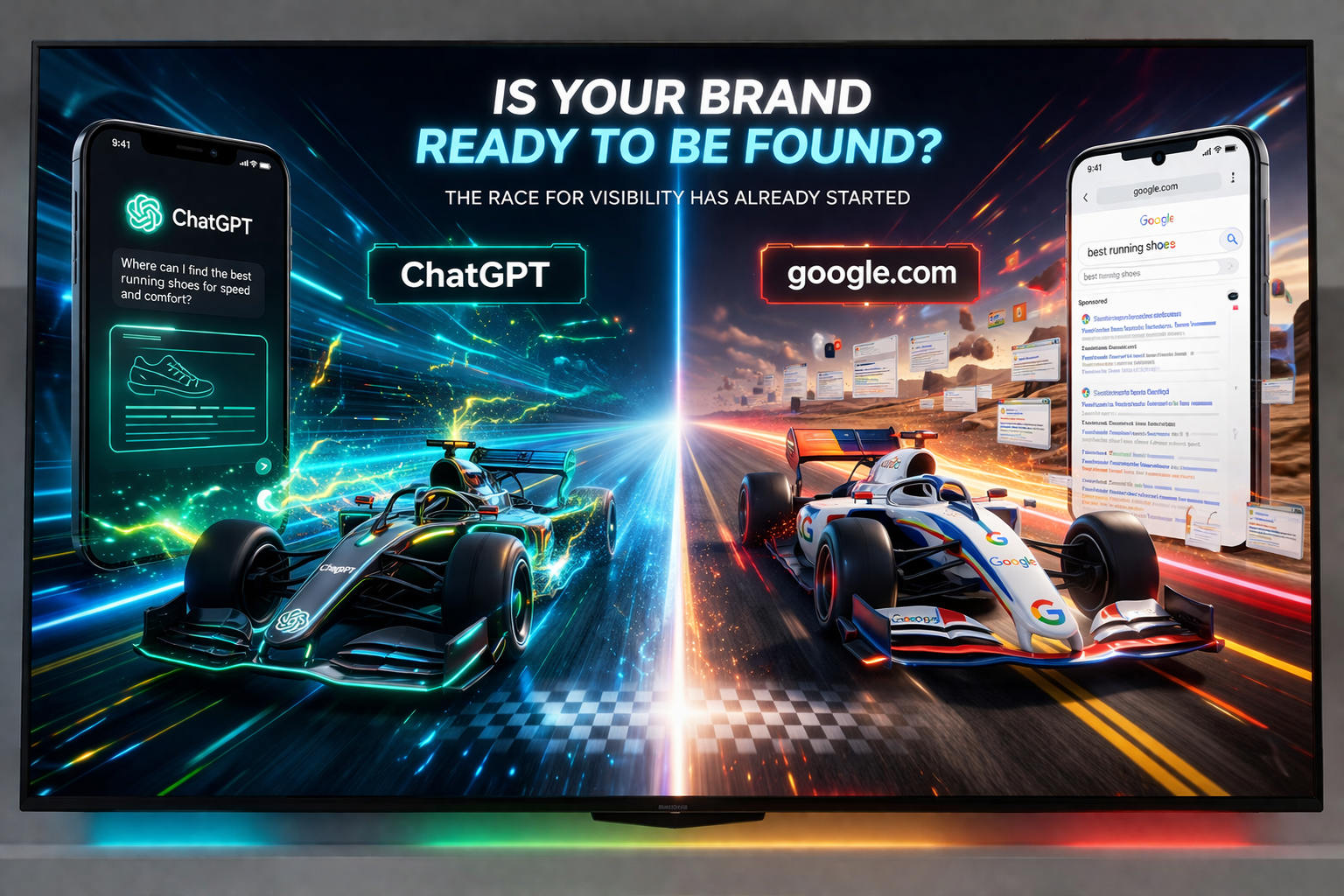
The image at the top of this article captures the reality perfectly: ChatGPT and Google are now racing side by side for the role of primary information gateway. ChatGPT has 800 million weekly active users. Perplexity grew 370% year-over-year. Google Gemini tripled its market share in twelve months. Meanwhile, 36% of people now use ChatGPT regularly for the kind of questions they used to type into Google. This is not a trend on the horizon — it is happening right now.
Companies that continue to invest only in traditional SEO will watch their traffic erode quarter by quarter, just as publishers who lost 26–70% of their visitors already have. Companies that invest in genuinely valuable, well-structured, expert content will be discovered by both channels — and will build a compounding advantage that is very difficult for competitors to replicate.
The question is no longer "Is your website optimized for Google?" The question is: "Is your brand ready to be found — by anyone, anywhere, through any channel?" If you are serious about AI integration and custom software development, your online presence should reflect that seriousness. Write for people. Structure for machines. Let your real expertise speak — and both humans and AI will listen.
Related Articles
AI Will Not Replace Software Engineers — But It Will Accelerate Our Society's Next Leap
3 min read
Why the AI hype around replacing programmers mirrors the fears of the computer revolution — and why adaptable engineers will thrive, not disappear.
How to Plan AI Integration for Enterprise Systems
2 min read
A practical guide to integrating AI into existing enterprise systems — from evaluating readiness to deploying production-ready solutions without disrupting current workflows.