AI-First Development: The New Era of Software Engineering (and How to Avoid Million-Dollar Pitfalls)
A Real Shift in How Software Gets Built
Software engineering is going through its biggest change since high-level programming languages. AI-First Development is no longer an experiment or a small productivity plugin. It changes how products are planned, designed, coded, and maintained.
Teams that adopt it well report development budgets cut by up to 60%. Teams that adopt it carelessly take on serious risk, and some of those mistakes cost millions.
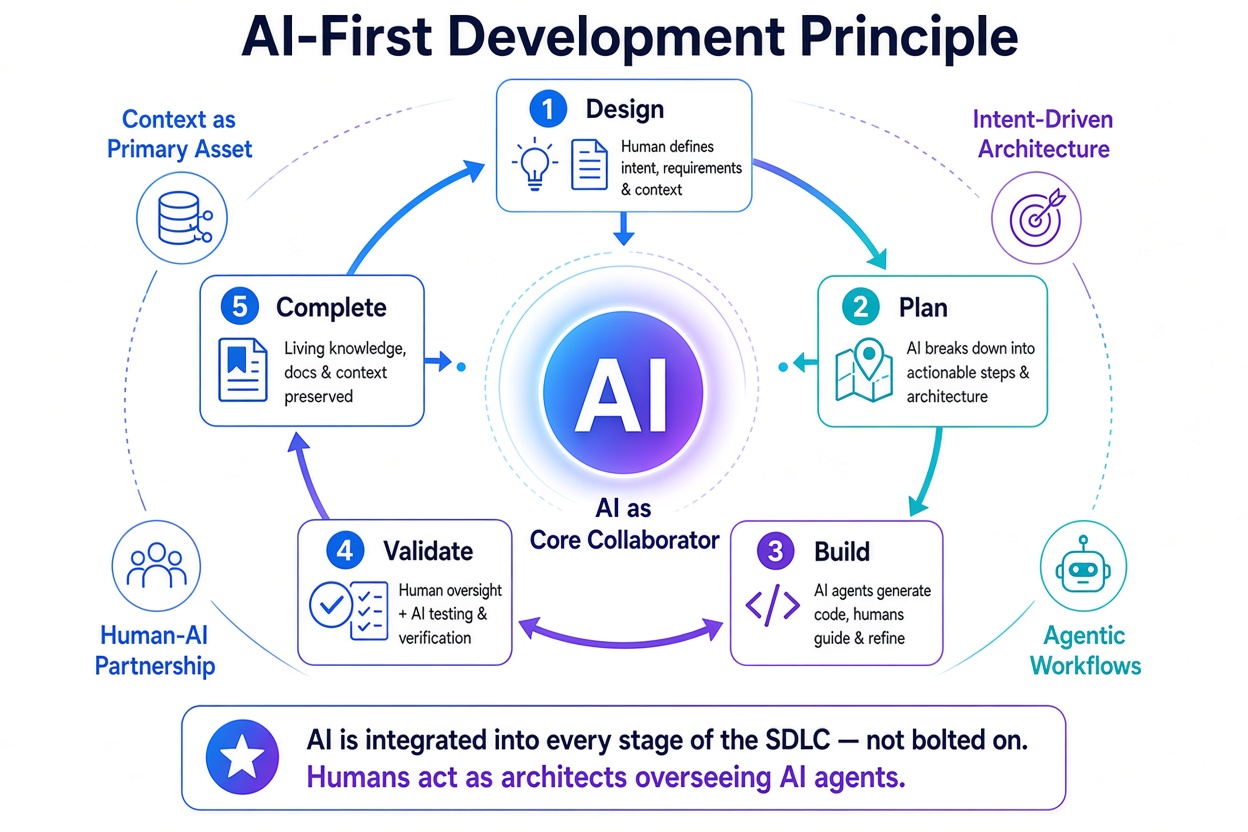
What Is AI-First Development?
In traditional development, people write every line. Engineers turn requirements into code, write the configuration, build the tests, and debug integrations by hand. AI-First Development turns this around.
In an AI-first team, coding agents and large language models (LLMs) do the heavy lifting: generating code, refactoring, scaffolding tests, and writing documentation. Retrieval-augmented generation (RAG) gives them the context they need. Engineers move from typing code to designing systems, writing clear instructions, reviewing output, and owning quality.
It rests on three things. First, intent-driven specifications: engineers describe business logic, domain models, and acceptance criteria in precise language or structured schemas, and agents produce the first implementation. Second, iterative refinement: agents run the tests, read the compiler errors, and fix their own code across many files before a person reviews it. Third, a codebase the AI can see: the whole repository is indexed, so the model can reason across service boundaries instead of guessing.
Why It Is the Future, and Where the 60% Comes From
The economics are hard to ignore. When boilerplate, tests, routine CRUD screens, and documentation are automated, a team ships far more with the same people.
Mature AI-first teams see three things. Lower budgets: routine features take days instead of weeks, which cuts the cost of an MVP and of ongoing maintenance — by up to 60%. Faster time to market: the path from idea to production gets much shorter. Faster prototyping: product managers and domain experts can test an idea with a working prototype instead of a slide.
The Hidden Danger: Naive AI Adoption
AI-first development is not a magic button. Companies that hand out AI coding tools without architectural oversight often lose the savings they expected, and more.
Silent logic errors. AI can write code that compiles and passes shallow tests but hides a business logic bug or a race condition that only shows up under load.
Security holes. Unreviewed AI code often brings in classic OWASP Top 10 problems: insecure deserialization, hardcoded secrets, unparameterized SQL. Attackers look for exactly these.
Technical debt. When developers paste unvetted AI snippets across many services, the codebase turns into something nobody can debug. Fixing it later can mean millions in refactoring and outages.
Legal and compliance risk. Sending proprietary code to public models, or shipping copied code without checking its license, exposes the company to real liability.
How to Do AI-First Development Safely
To get the savings without betting the company, engineering leaders need a few firm rules.
1. Keep a human in the loop. AI proposes; people decide. Every line of AI-generated code goes through static analysis, security scanning, and review by a senior engineer before it is merged.
2. Give the AI your context, not just the internet's. Do not rely on generic public models alone. Give your agents a private knowledge base with your coding standards, architecture, and approved libraries, so their output follows your rules.
3. Train your engineers for this work. Beyond coding, they need to write good prompts, verify AI output, think about the threats AI code can introduce, and practice test-driven development (TDD).
Conclusion
AI-First Development is where software engineering is going. It brings real speed and real savings. But the winners will not be the teams that trust AI blindly. They will be the teams that pair AI speed with strong human ownership of architecture, security, and engineering standards.
That is how we work at ITFriends.AI. Our senior engineers use AI agents every day, with review, testing, and architecture kept firmly in human hands. If you want the speed of AI-first development without the pitfalls, let's talk.
Related Articles
Who Is Easier to Explain What to Do: AI or a Human Software Developer?
7 min read
After years of managing development teams while still writing code myself, I asked a simple question: is it easier to explain a task to AI or to a human developer? The answer says a lot about where software teams are heading in 2026.
AI Will Not Replace Software Engineers — But It Will Accelerate Our Society's Next Leap
3 min read
Why the AI hype around replacing programmers mirrors the fears of the computer revolution — and why adaptable engineers will thrive, not disappear.