Astra AI: AI Software Design Directly in Figma
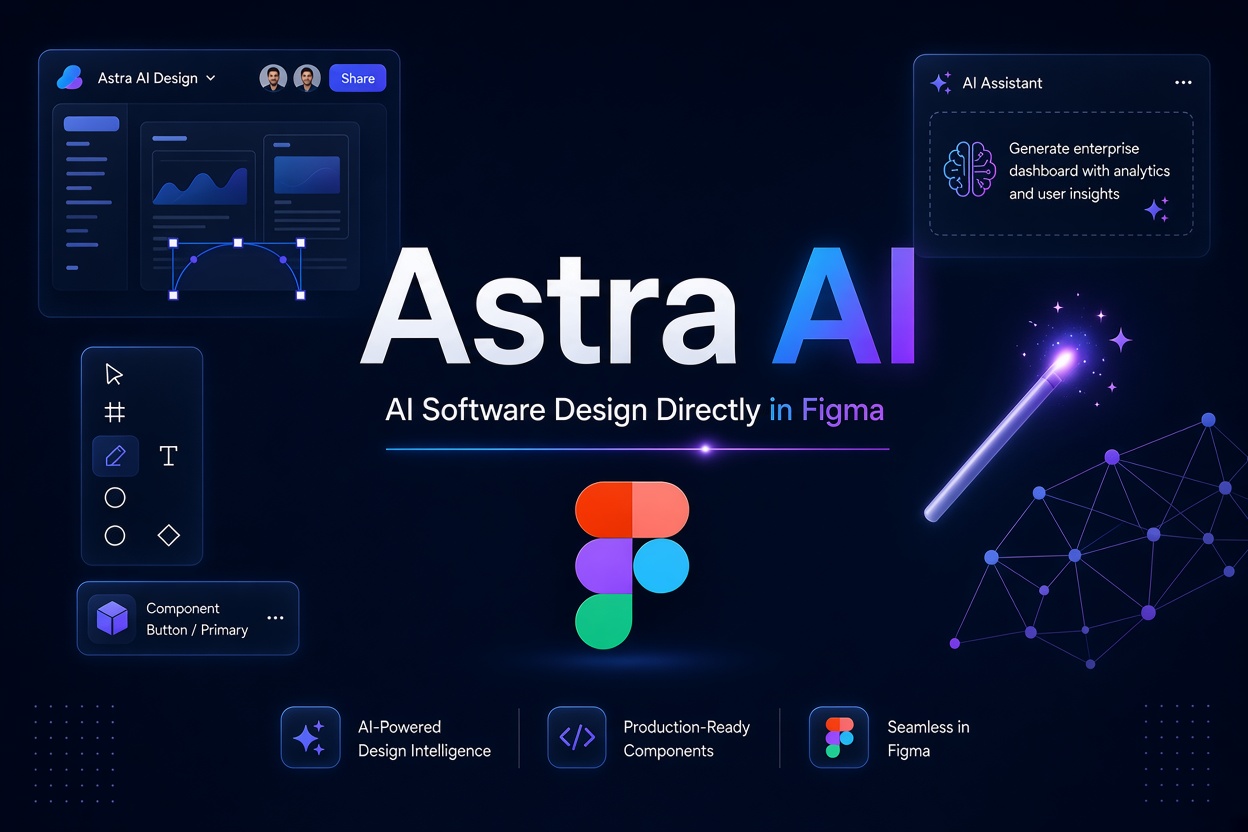
From a Blank Whiteboard to a Production-Ready Mockup
It is Monday morning and your product team has an idea for a new platform. Turning that idea into clean, professional mockups normally takes weeks. Someone has to wireframe the screens, align every box, and settle a long argument about padding.
Astra shortens that. You type a sentence, and a complete, production-ready layout appears on your Figma canvas.
We do custom software development for a living, so we watch AI software design tools closely. Speed, precision, and good handoffs decide whether a project ships on time. Astra is the first AI we have seen that builds real UI designs inside Figma instead of pictures of them.
The Design Bottleneck Astra Removes
Generative AI has been good at concept art, color palettes, and static images of interfaces for a while. The problem was what came next. If you liked an AI-generated layout, a designer still had to rebuild it by hand in Figma: trace the shapes, guess the font sizes, start the file from scratch.
That step was the bottleneck. Design is not only how a screen looks. It is how it behaves. A real interface needs responsive grids, Auto Layout constraints, component states, and a design system it actually follows. Earlier tools did not speak Figma's language.
Astra does. It closes the gap between generated ideas and a structured vector file you can edit.
What Makes This Real AI Software Design
Astra is not trained to paint pixels. It is built to understand interaction, spatial hierarchy, and design system logic.
When you prompt it, it does not return a flat JPEG. It works directly against the Figma document model. It creates master frames, wraps elements in responsive Auto Layouts, applies real padding values, and instantiates component variants.
That is the difference between an AI picture of an interface and AI software design. You get a clean, editable, production-grade file right away.
Watching It Work on a Live Canvas
Say you are building a financial analytics platform. You select your workspace in Figma and prompt: "Design a modern crypto trading dashboard with a collapsible sidebar, a live ticker row, a candlestick chart area, and an order execution panel in dark mode."
Within seconds you have a 1440px desktop frame with a structured 12-column grid. The sidebar builds itself from nested Auto Layouts, with icons and active-state indicators. Ticker cards and order tables instantiate cleanly, linked to your typography and color tokens. Dark mode variables bind automatically, so you can toggle themes with one click.
This is not a static mockup. It is a working Figma file, ready for a designer to refine.
What This Changes for AI UX and UI Work
Good software starts with good user experience. AI UX and UI tooling changes how much of that work a team can explore before committing to a direction.
Designers and product managers can test dozens of layout variations in the time one used to take. Want to see the checkout flow as a single column instead of three? Ask. Need every button state — hover, pressed, disabled, loading — across the component library? That takes seconds.
This does not remove the designer. It frees them. Less time moving pixels, more time on strategy, user needs, and the hard problems.
How We Use AI Software Design in Custom Development
We turn client requirements into scalable software. Adding AI software design to our delivery process has changed how we run discovery and prototyping on custom software development projects.
Early client workshops usually produce whiteboard sketches and abstract requirements. With Astra in our Figma workspace, our designers and architects can turn feedback into a live prototype during the meeting. Stakeholders see their idea on screen immediately. That builds alignment early, removes misunderstandings, and cuts discovery time significantly.
The handoff improves too. Astra produces clean layer hierarchies and sensible naming, so our frontend engineers receive tokenized structures that map directly onto React or Angular components. For a nearshore team working across time zones, that clarity matters — the design file answers questions that would otherwise wait a day for a reply.
From Napkin Sketch to Clickable Prototype in a Day
Here is a practical example. A healthcare client needs a mobile patient portal. They arrive with a napkin sketch of the appointment booking flow.
Instead of sending designers away for two weeks of wireframing, the team uploads the sketch into Figma and prompts Astra: "Convert this rough sketch into a polished, accessible mobile health app interface using our healthcare design system."
Astra reads the layout, recognizes standard patterns like date pickers and doctor profile cards, and produces a styled mobile frame that meets WCAG contrast requirements. A senior UX designer then refines the micro-interactions. By the afternoon there is a clickable prototype ready for user testing.
What used to take half a month takes an afternoon.
Where Design Fits Into AI Integration Services
Most conversations about AI integration services start at the back end: models, data pipelines, retrieval, APIs. Design is treated as a separate track that happens before or after. Tools like Astra make that split harder to justify.
If the same project can generate its interface, its component library, and its service layer with AI assistance, the gain is not one faster step. It is a shorter path from requirement to working software. That is the part our clients actually pay for.
The Point Is Collaboration, Not Replacement
Tools like Astra show where software development is heading, and it is not humans against machines. AI handles structural layout and repetitive styling. People bring judgment, empathy, and direction.
If you are planning a product and want to move from idea to prototype in days instead of weeks, we can help. ITFriends.AI provides AI integration services and custom software development with a nearshore team of senior engineers, turning ideas into production-ready software.
Related Articles
AI-First Development: The New Era of Software Engineering (and How to Avoid Million-Dollar Pitfalls)
4 min read
AI-First Development can cut software budgets by up to 60%. Without review, security checks, and clear architecture, it can also cost millions. Here is how to get the savings without the risk.
The Biggest Misconception About AI: "Just Give It a Task"
7 min read
AI executes tasks well, but someone still has to define the task. Why defining the problem, not writing the code, is becoming the real bottleneck.