The Biggest Misconception About AI: "Just Give It a Task"
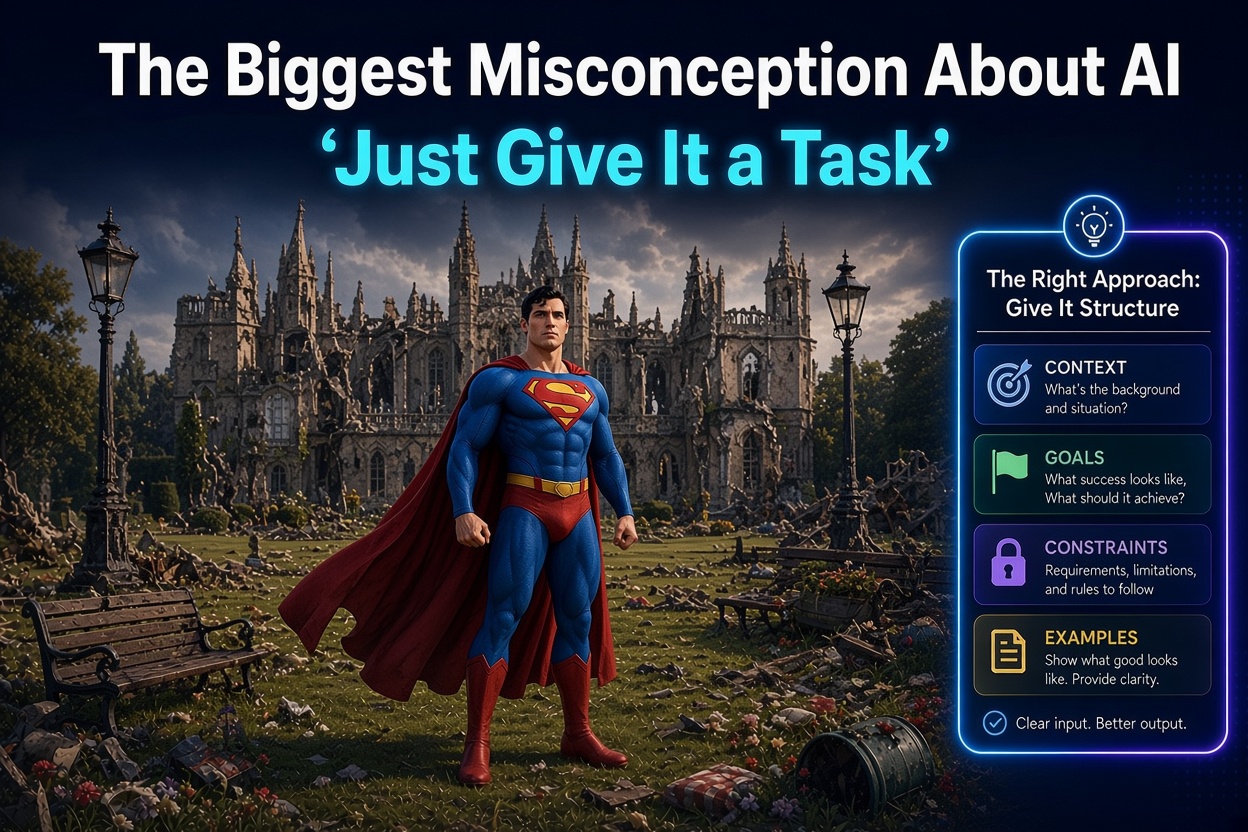
The Biggest Misconception About AI
We hear it everywhere. AI will replace programmers. AI will replace designers. AI will replace analysts. AI will replace managers. AI will change the world.
There is certainly some truth behind these statements. AI is already changing the way people work, and its capabilities are improving at an extraordinary pace.
But there is one fundamental misconception that often gets lost in all the excitement: people assume that you can simply give AI a task and it will independently deliver the result you want.
In some cases, that is true. In many important cases, it is not. And understanding the difference is becoming increasingly important.
"Great! I Do Not Have to Work Anymore."
Imagine the following scenario. Someone discovers that modern AI models can write software, create designs, analyze documents, generate presentations, write marketing copy and perform dozens of other tasks.
The obvious reaction is: "Fantastic. I do not need to do this myself anymore. I will just give the task to AI."
And if the first attempt is not good enough? No problem. Subscribe to a more powerful model. Maybe spend $200 per month instead of $20. Or use several AI models simultaneously. Give the same task to five different models and choose the best result.
It sounds like a reasonable strategy. Until you actually try it. Because something unexpected often happens: you get a result, but it is not the result you wanted.
And this distinction is crucial. AI did not necessarily fail. The problem may be that the task was never properly defined in the first place.
AI Is Very Good at Solving Problems. But Who Defines the Problem?
Consider a simple example from our own world: custom software development. Imagine that a partner approaches us with a new project and says: "We need to develop an e-commerce app."
That is it. No detailed requirements. No user journeys. No explanation of the business model. No information about the target audience. No description of the existing systems. No payment requirements. No logistics model. No administration requirements. No explanation of what makes this e-commerce application different from thousands of others.
Now take that exact sentence and give it to an AI model. What happens? The AI will probably produce something impressive. It may generate a project structure, database schema, UI concepts, APIs, code and even a working prototype. And it may look surprisingly good.
But there is a very high probability that it will not be the application the business actually needs. Why? Because "e-commerce app" is not a specification. It is barely even a requirement. It is a starting point.
The Missing Ingredient Is Not AI. It Is Understanding.
Now imagine a completely different scenario. Before talking to AI, an experienced product owner, architect or software developer has already thought through the project.
They know who the users are and what they need to accomplish. They know how products are organized, how orders should work, what payment methods are required and how delivery works. They know what happens when an order is cancelled and how returns are processed. They know what administrators need to see, which external systems must be integrated, and what the business rules are. They know what the first version should and should not contain, and what the expected user experience should be.
Now the conversation with AI becomes completely different. Instead of "build me an e-commerce application", the instruction becomes something closer to: "First create the product catalog structure with these entities and relationships. Then implement the customer registration flow. After that, implement the shopping cart according to these rules. Once that works, add checkout using these payment scenarios. Finally, integrate the order management workflow with these specific business rules."
Now AI has something much more valuable: direction. And the results can be dramatically better.
AI Amplifies the Person Using It
This is, in our view, one of the most important things to understand about AI. AI does not simply replace expertise. It amplifies expertise.
A person who understands the problem deeply can use AI to move incredibly fast. A person who does not understand the problem may simply produce a lot of very sophisticated-looking output that does not solve the actual problem.
This is particularly obvious in software development. An experienced developer can look at an AI-generated implementation and immediately ask whether the architecture is appropriate, whether it will scale, whether the data model is correct, and what happens in edge cases. Is the security model sufficient? What happens when an external API fails? Is this maintainable? Does it actually match the business requirements? Are we solving the right problem?
AI can help answer many of these questions. But somebody still needs to ask the right questions.
The "AI Did It" Illusion
There is another interesting phenomenon happening. AI can produce something that looks finished very quickly.
A prototype may have beautiful screens. A generated application may compile. An AI-generated report may contain dozens of pages. A chatbot may provide a confident answer. A piece of code may pass a few tests.
This creates a dangerous illusion: the work is done. But producing output and producing the right output are two very different things. The more complex the task, the more important this distinction becomes.
For simple, well-defined tasks, AI can often work almost autonomously. For complex tasks, AI still benefits enormously from someone who can provide context, make decisions, review results and continuously adjust the direction.
The Future Is Not "AI Versus Humans"
We believe the more interesting question is not "will AI replace humans?" It is this: what happens when people who know what they are doing become dramatically more productive because of AI? That is where the real transformation is happening.
A good software developer with AI tools can potentially accomplish much more than a developer working without them. A good architect with AI can explore more alternatives. A good product manager can analyze more information. A good designer can create and iterate faster. A business expert can turn an idea into a prototype much more quickly.
But the human still provides something extremely valuable: judgment.
The New Bottleneck Is Knowing What You Want
For decades, technology was limited by computing power, development resources and the time required to create software. AI changes this equation.
Generating code is becoming cheaper. Generating content is becoming cheaper. Creating prototypes is becoming cheaper. Analyzing information is becoming cheaper. In many cases, the bottleneck is moving somewhere else.
The bottleneck is increasingly the ability to define the problem correctly. What exactly are we trying to achieve? Why are we building it? What are the constraints? What decisions need to be made? What does success look like? What should the system do when something unexpected happens?
These questions do not disappear because AI becomes more powerful. In fact, they become more important.
What We See Every Day
At ITFriends, this is something we encounter on a daily basis. Our work involves custom software development and AI integration, and we regularly see the difference between asking AI to build something and actually knowing what needs to be built.
This is one of the areas where our experience becomes particularly valuable. We do not see AI as a replacement for our developers, architects or business analysts. We see it as an extremely powerful tool that allows our team to work faster, explore more possibilities and deliver more value.
But before AI can execute effectively, somebody needs to understand the business problem, break it down into meaningful tasks, define the expected outcome and evaluate whether the result is actually correct. That is where our experience matters.
AI Is Powerful. Direction Is Even More Important.
The biggest misconception about AI may not be that AI is going to replace everyone. It may be the opposite: people underestimate how much expertise is required to use AI effectively.
Give AI a vague task and you may get an impressive but irrelevant result. Give AI a clearly defined problem, good context, meaningful constraints and continuous feedback, and the results can be extraordinary.
The future therefore is not necessarily about choosing between AI and people. It is about combining the two. AI provides extraordinary execution power. People provide context, judgment and direction.
And the organizations that understand how to combine these capabilities will have a significant advantage. At ITFriends, helping businesses make that combination work is exactly what we do, every day.
Related Articles
Is Your Brand Ready to Be Found? Why AI Engines — Not Just Google — Now Decide Your Visibility
7 min read
The race for online visibility has changed. Traditional SEO alone is no longer enough — AI engines like ChatGPT now decide which brands get recommended. Learn how to make your website discoverable by both humans and AI.
AI-First Development: The New Era of Software Engineering (and How to Avoid Million-Dollar Pitfalls)
4 min read
AI-First Development can cut software budgets by up to 60%. Without review, security checks, and clear architecture, it can also cost millions. Here is how to get the savings without the risk.